What is a Repositioning Cruise?
A repositioning cruise is a one-way voyage where a ship relocates from one cruising region to another at the end of a season — for example, crossing from the Mediterranean to the Caribbean each autumn. Because these sailings exist to move the ship rather than to sell a specific destination, they're often priced to fill cabins fast, which is why they've become a favourite with savvy cruisers who don't mind a few extra sea days for a much better fare.
Though some ships spend the entire year sailing identical itineraries in a single location, many relocate to follow the sun. As part of their itinerary planning, cruise lines move ships from one cruise region to another, referred to as repositioning cruises or relocation cruises. Very few ships stay in Europe as the season turns from autumn to winter, for instance.
Between September and November, ships start crossing from the UK and Europe to the US and the Caribbean. Depending on the routing, some call at Iceland, Greenland, or Canada en route, or take in the Fall foliage in New England. In spring, many ships that spent winter in the Caribbean and South America head back to the UK and Europe via the Azores, the Canary Islands, and the Iberian Peninsula. These one-way voyages often carry discounted fares to attract guests onto a non-regular sailing schedule.
Repositioning Cruises are Also Known As
Cruise line marketing teams are creative when it comes to selling repositioning cruises. Many are "Themed," with topics ranging from food-and-wine extravaganzas to theatre and big band music. Onboard enrichment programmes and guest speakers also add to the appeal.
You'll also see them marketed as "Transit" or "Transition Cruises," "Eastbound" or "Westbound Crossings," "One-Way," "Panama Canal," "Suez Canal," "Transpacific," and "Transatlantic." Some ultra-luxury lines — including Regent Seven Seas — now market longer repositioning-style voyages as "Extended Explorations," covering routes like Europe to Asia or Australasia.
Related: Guide to Themed Cruises

Where do Repositioning Cruises Go?
The most common route is transatlantic — Caribbean/Florida to European ports and back. Winter and spring are the busiest times to cruise the Caribbean, when the weather is at its best; once summer arrives, Mediterranean and European itineraries take over.
As a result, cruise lines reposition their fleets from Florida to Europe in late spring — ships based in Fort Lauderdale or Miami over winter often move to Barcelona or Rome to run summer itineraries — then reverse the move in autumn.
Transatlantic crossings are the most common, but there are several other seasonal repositioning routes worth knowing:
Spring (March–May):
- Caribbean, Florida, and other southern US ports to European ports
- Caribbean, Florida, and other southern US ports to Pacific Northwest ports such as Vancouver
- South America to Europe (less frequent, and often on European lines)
- Australia to Asia (particularly Singapore)
- Asia/Oceania to the Pacific Northwest (less frequent)
Occasionally, a line will reposition a ship onto a new itinerary permanently rather than seasonally — these odd-route sailings are worth digging for with creative search filters. We've come across one running from Australia through the Pacific islands to Hawaii.

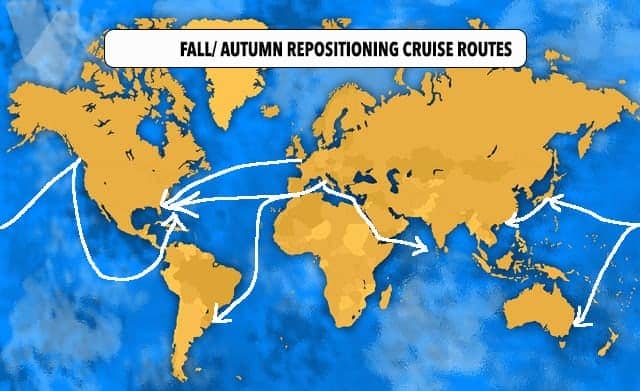
Fall/Autumn (September–November): essentially the reverse of the above —
- Europe to Caribbean, Florida, and other southern US ports
- Pacific Northwest (e.g. Vancouver) to the Caribbean, Florida, and other southern US ports
- Europe to South America (less frequent, and often on European lines)
- Asia (particularly Singapore) to Australia
- Pacific Northwest to Asia/Oceania (less frequent)
We've sailed one of the rarer routings ourselves: Europe to India and Dubai via the Suez Canal, on Seabourn, one of our favourite lines.
Related: Ten Reasons We Love Cruising with Seabourn
Longer Voyages and More Relaxing Sea Days
Book a repositioning cruise and you should expect fewer ports of call and more days at sea — more time to relax and use the ship rather than rush ashore. That's not a downside: cruise ships offer more than enough onboard activity to fill the time, and a run of sea days is a rare chance to properly switch off. Larger ships in particular tend to have the activity range to make several days at sea fly by.

Value for Money
Repositioning cruises offer some of the best deals in the cruising industry. It's a cost-effective way to cross between the US and Europe if you have the time to spare, since cruise lines are motivated to fill cabins on a sailing that exists purely to move the ship.
We've seen transatlantic repositioning fares priced well below a typical per-day rate for the same cabin category on a standard sailing — always compare the daily rate against a line's regular sailings rather than judging the headline fare alone.
Fewer Guests on Board
We've consistently found fewer guests onboard transatlantic repositioning sailings — more space to relax, and a crew that isn't stretched as thin. The crew-to-passenger ratio shows how many guests each crew member is expected to look after; on the most attentive ships, that ratio approaches 1:1 or better, which in theory means noticeably more personal service.
Related:
Understanding the Crew to Passenger Ratio
The Passenger Space Ratio
Enrichment Programs
These programs are one of the big plusses for us. Most cruise lines offer extensive enrichment programs allowing you to expand your mind (at the same time as increasing your waistline with all the tempting food choices onboard). We have found that Cunard and Seabourn have some of the best enrichment programs.
You could learn to cook, dance, play the organ or perhaps bridge is your thing?. We have even experienced learning about photography, how to create videos, and much more. It's like taking half a dozen adult education classes all in one week!
Entertainment
This is one of our favourite parts of a repositioning crossing.
Most lines run extensive enrichment programmes that let you expand your mind while quietly expanding your waistline with all the food on offer. We've taken cooking classes, tried our hand at dance, and picked up photography tips and basic video editing along the way — it's like fitting half a dozen adult-education classes into a single week at sea.
No Jet Lag
Our first transatlantic repositioning cruise was with Cunard. To sidestep the usual time-zone disruption, the ship's clock is adjusted by one hour at noon each day rather than shifting all at once. Crossing east to west this way, you effectively gain an extra hour of sleep every couple of nights instead of losing several hours in one go — so you arrive with no jet lag at all.
World Class Locations
Repositioning cruises typically begin or end in some of Europe's finest cities — Rome, Lisbon, and Barcelona are the most common, alongside Athens and Venice.
Whichever port you land in, it's worth building in time: wander the architecture in Barcelona, take a gondola along a Venetian canal, or get lost in the antiquities of Athens or Rome.
Unusual or Offbeat Ports of Call
A transatlantic repositioning cruise will often call at one or more of the more offbeat islands off West Africa: Madeira, a floral corner of Portugal with unusual hiking trails and watercourses; the Azores, also Portuguese, known for whale-watching and pineapple plantations; or the Canary Islands, where dormant volcanoes and near-permanent spring weather make for a striking stop. Other common ports include Malaga and Cadiz on Spain's southern coast, and Tangier and Casablanca in Morocco.
These calls tend to be a little further off the beaten track than a standard Caribbean or Mediterranean itinerary — one of the quieter appeals of choosing a repositioning route.
Discounted New Ship Experiences
Sailing a brand-new ship can be expensive, especially on an inaugural voyage. Since most cruise ships are built in European shipyards, new ships often have to reposition to a home port elsewhere in the world before their season starts — and those initial relocation voyages can often be booked at a discount. It's a genuinely good way to experience a new ship early, while calling at ports across two continents.
Common stops include Malaga and Vigo in Spain, Lisbon, and Halifax, Nova Scotia.
An Alternative To Flying
Next time you're pricing an international flight, check whether a repositioning cruise is heading the same way. Instead of a cramped economy seat and the jet lag that comes with a long-haul flight, you get several unhurried days at sea in a private stateroom, arriving relaxed rather than wrung out.
Let Us Answer Your Questions
Where Do Repositioning Cruises Go?
Most commonly, transatlantic — between Caribbean/Florida ports and Europe. There are also seasonal routes between Europe and South America, Australia and Asia, and the US West Coast and Alaska/Asia, depending on the time of year.
Are repositioning cruises worth it?
For the price, yes — fares are often well below a typical sailing because the line mainly wants to offset the cost of moving the ship. Add in fewer crowds and more sea days, and for anyone who enjoys life onboard as much as the ports, it's an easy sell.
Are Repostioning Cruises Crowded?
Generally not. They often sail below capacity, so there are fewer passengers sharing the same crew — which tends to mean more attentive service, not just the impression of it.
Why Are Repositioning Cruises Cheaper?
Mainly the high ratio of sea days to port days, and the fact that the line is repositioning the ship regardless of how full it is. Book too early, though, and you can miss last-minute deals that often appear closer to departure.
Is a repositioning cruise a good first cruise?
It can be, if you're comfortable with several consecutive sea days rather than a new port each morning. If you'd rather have a full daily itinerary of shore excursions, a standard Caribbean or Mediterranean sailing is a better starting point.
How long is a typical repositioning cruise?
Transatlantic crossings usually run 10–16 nights depending on the ports included en route; Extended Exploration-style repositioning voyages between continents can run several weeks.
Not Sure Which Line Is Right for You?
We've sailed Seabourn, Silversea, Cunard, Oceania, Regent Seven Seas, Scenic and Uniworld — with the honest reviews to go with it. Browse our cruise line guides to see how they actually compare beyond the price tag.
MORE FROM ABOUT LUXURY CRUISING
Explore Our Cruise Line Spotlights
We've sailed these cruise lines ourselves. Before you book, read our full first-hand breakdown of the fleet, dining, suites and value for each of these ultra-luxury lines.